

CONTENTS
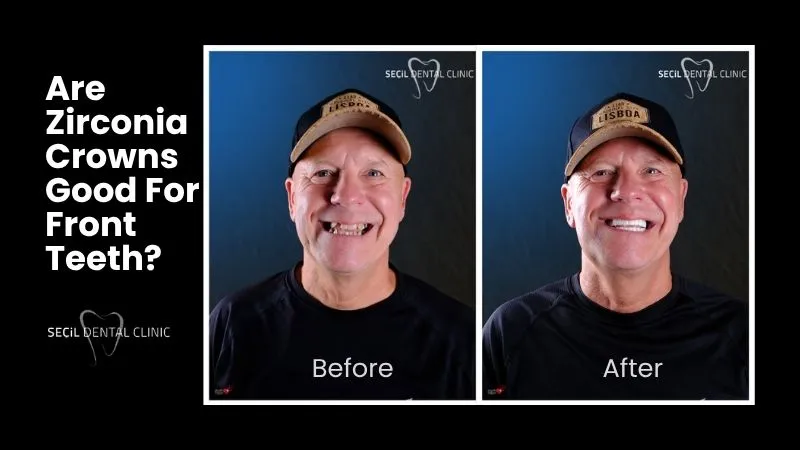
Yes. Zirconia crowns for front teeth can provide a natural-looking, durable restoration when a tooth needs a crown. The result depends on the zirconia selected, the colour underneath it and how the crown fits into your smile. Choosing the brightest shade alone will not give you the most natural result.
You may want to replace an old crown that stands out, change the shape of a damaged tooth or improve several front teeth together. Those are different starting points. At Seçil Dental Clinic in Antalya, Turkey, you can discuss what you want to change and whether a crown is the right way to achieve it.
Yes. With suitable material and carefully planned colour, shape and surface details, zirconia crowns look natural on front teeth. A close colour match is only part of the result: brightness, surface texture and the way the crown responds to light also affect how well it blends with neighbouring teeth.
Share what bothers you about your current smile and the result you have in mind. Contact Seçil Dental Clinic in Antalya, Turkey, to discuss your options before deciding on treatment.
Discuss my crown optionsYour front teeth sit in full view whenever you speak or smile. A crown that looks fine on its own may seem a little flat beside a natural tooth with a translucent biting edge. Dentists and laboratory technicians therefore plan the whole appearance rather than stop at choosing a shade.
A single zirconia crown on a front tooth has a demanding job. It needs to sit beside teeth you are keeping, often including the other central incisor—the tooth people naturally compare it with.
Natural teeth contain variations in colour. The area near the gum may look warmer, while the biting edge lets more light through. Photographs and shade records help the laboratory reproduce those details; choosing the same shade code does not, by itself, ensure a match.
If you want to whiten the surrounding teeth, mention this before agreeing on the crown colour. Whitening changes natural teeth, not the shade of the ceramic crown.
Brightness needs balance. A lighter crown can still look natural, but a very bright, uniform surface may draw attention to itself when the neighbouring teeth have more depth.
High-translucency zirconia crowns for front teeth let more light through than more opaque zirconia formulations. This helps with appearance, although the most translucent option is not automatically the right one. A dark tooth underneath may need more masking; a heavy bite brings the balance between strength and translucency into focus.
The American Dental Association describes this trade-off: increasing zirconia’s translucency can reduce its mechanical strength. Dentists therefore select the formulation according to the tooth’s colour and the forces it carries, rather than simply choosing “the most natural zirconia”. [1]
Colour is only part of it.
The two central incisors usually differ in shape and width from the smaller teeth beside them. Keeping those distinctions helps a restored smile look believable. Making every front tooth equally wide or giving each one the same straight edge can change that impression.
Length affects the appearance too. During planning, dentists assess how much tooth shows with your lips relaxed, how the new edges relate to the lower teeth and whether you can speak comfortably. Excess bulk around the gumline affects both appearance and cleaning. The contours in this area allow a natural transition and access for daily cleaning.
Zirconia can be suitable when a front tooth already has a large restoration, substantial damage or an old crown that needs replacing. For a healthy tooth with a small cosmetic concern, the first question is whether it needs full coverage at all.
Before recommending a zirconia crown for front teeth, dentists assess the remaining tooth, gum health and bite. A strong material cannot make up for an untreated problem underneath it.
If one front tooth needs to match particularly translucent natural teeth, dentists consider E-max (lithium disilicate) as an option. Its optical properties help reproduce the depth and light transmission of enamel. Zirconia may suit another tooth where masking a darker foundation or managing loading matters more.
A useful zirconia vs E-max crowns for front teeth comparison is specific to your mouth. Ask your dentist what each option would change about the appearance and preparation of your tooth, and why they favour one.
A crown covers the tooth all the way around; a veneer mainly covers its front surface. Both treatments involve assessing the existing tooth structure, and a crown generally requires more tooth reduction.
If your concern is a small chip, colour or a minor shape difference, discuss whether whitening, bonding or a veneer could address it with less intervention. A tooth with extensive damage may need the coverage of a crown. Treatment selection follows what the tooth needs as well as the smile you want.
Yes. There is no automatic requirement to crown every visible tooth.
How many crowns you need comes down to the condition of your teeth and how the new crowns will blend with those left unchanged. One replacement crown might be enough. Several teeth may need coordinated treatment when their existing restorations or shapes differ substantially.
Want a much lighter smile? Discuss the colour transition before preparation begins, especially if darker side or lower teeth will remain visible. That does not mean those teeth also need crowns. The plan takes the teeth you are keeping into account.
For an overview of the treatment, visit our zirconia crowns page.
Look at the crowns with your lips relaxed, then smile. Check the appearance from a normal conversational distance as well as close up; each view reveals different details.
During the trial fitting, discuss:
Temporary crowns will not reproduce every detail of the finished ceramic. Dentists explain which features you are assessing at each stage. If something looks off, say so before final fitting—depending on the issue, the crown can be adjusted or remade by the laboratory.
Start with the change you want, rather than a fixed number of crowns. Perhaps an old front crown looks grey, or you want a softer tooth shape without a very white finish. Tell the dentist that. Zirconia crowns before and after photographs help explain your preference, but your own teeth and bite guide the treatment plan.
When discussing zirconia crowns in Antalya, ask which teeth need full coverage, how the crowns will match the teeth you keep before permanent fitting. You can contact Seçil Dental Clinic in Turkey to discuss those questions and arrange an assessment.
Tell Seçil Dental Clinic what you would like to change about your smile. Share clear photographs for an initial discussion; your examination in Antalya includes an assessment of your teeth and bite, which helps establish the treatment options.
Discuss my front teethThere is no fixed replacement date. A 2026 systematic review and meta-analysis by Pjetursson and colleagues, published in the International Journal of Prosthodontics, evaluated 64 clinical studies of single crowns supported by natural teeth. It estimated five-year survival at 96.8% for monolithic zirconia crowns and 97.3% for zirconia crowns with a ceramic covering. [2]
The review found similar performance in front and back teeth for these zirconia categories. These figures describe crowns remaining in service, not a guarantee of trouble-free treatment or a prediction for every modern zirconia product. Your tooth health, bite, crown design and maintenance still matter.
[1] American Dental Association — Materials for indirect restorations.
Make An Appointment Today With Our Online Form