

CONTENTS
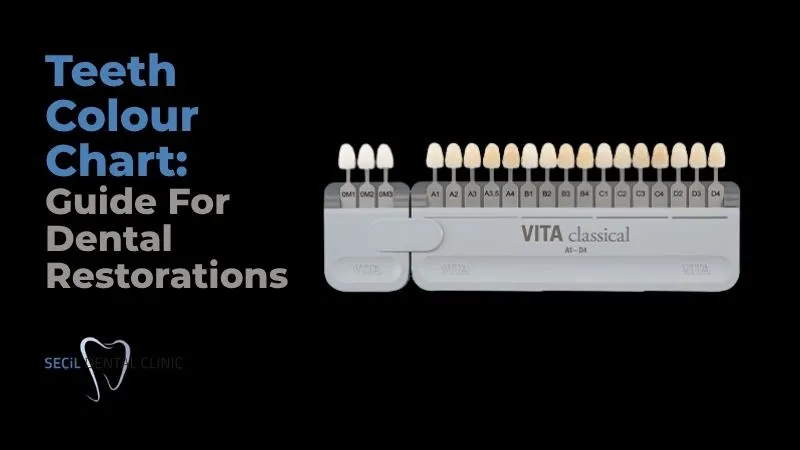
A teeth colour chart is simply a set of tooth shades dentists use to find the colour that looks right in your mouth. Tooth shade guides, also called dental shade guide, have been used for decades, and systems such as VITA Classical have become standard references in modern dentistry.
Every person is unique, and so are their teeth in shape and shade. When whitening or reshaping teeth, dentists use a dental shade guide to ensure the right colour is chosen for the patient.
Teeth shades chart is mainly used for dental crowns, implants, veneers and composite bonding treatments. Dentists place the shade samples next to your natural teeth and compare them directly. This helps us see which colour blends in best.
It also makes things much easier for you. Instead of trying to explain 'I want it a bit whiter' or 'I want a natural colour,' you can actually see the shades and compare them.
Your dentist will guide the choice by looking at your natural teeth, the teeth around the area and the kind of result you want.
The letters and numbers on a teeth shades chart tell us two things: the basic colour tone of the tooth and how light or dark that shade is.
On the VITA Classical shade guide, the letters show the colour family: A, B, C, D.
The number then shows the shade level within that colour family. Lower numbers are generally lighter, while higher numbers are darker.
The VITA Classical chart is one of the most common shade guides we use in dentistry. It has 16 tooth shades, from A1 to D4, grouped by their main colour tone.
The colour groups are:
The numbers help show how light or dark the shade is within each group. For example, A1 is lighter than A3 or A4.
You may see shades such as A1, A2, A3, B1, B2, C2 or D3 written in your treatment plan. We use these codes when choosing the colour of crowns, veneers, bridges and composite bonding.
One important point is that the chart is not a simple “white to dark” scale. A B1 tooth, for example, can look brighter than some A shades even though it belongs to a different colour group. That is why we usually compare several shade tabs next to your natural teeth before making the final choice.
A natural teeth colour chart shows the shades that real, untreated teeth commonly have.
Turkey teeth shades are basically shade guides, but the word 'natural' is used to separate these everyday tooth colours from very bright cosmetic shades. Natural teeth are not usually pure white. They have slightly yellow, cream, grey or brown tones.
Dentists use these natural shades when they want a crown, veneer or bonding to blend in with the teeth around it. A1, A2 or B2, for example, may be chosen when the aim is a realistic result rather than a very bright 'Hollywood white' look.
'Turkey teeth colour chart' is not a separate shade system. Dental clinics in Turkey use the same well-known tooth shade charts we mentioned above.
The most common one is the VITA Classical guide, with shades such as A1, A2, A3, B1, B2, C2 and D3. Some clinics may use newer systems such as VITA 3D-Master, especially when a more detailed shade match is needed.
For cosmetic treatments, you may also hear names like BL1, BL2, BL3 or OM1. These are brighter shades and are chosen especially for porcelain veneers or full smile makeovers for a whiter result.
The same tooth shade can look different on each person because we do not see tooth colour on its own. We see it together with the face, lips, gums and the teeth around it.
Skin tone is one of the biggest factors. A shade that looks very white on one person may look softer on someone else.
Tooth size and shape matter too. The same shade can look stronger on larger teeth and more natural on smaller ones. The colour of the nearby teeth also changes the overall look.
Light is another important factor as well. A shade may look one way in the clinic and slightly different in daylight.
That is why we do not choose a shade by looking at the chart alone. We check how it actually looks on your face and in your smile.
At Seçil Dental Clinic in Antalya, when we choose the most suitable tooth shade for you, we look at the whole smile, not just one colour on a chart.
We usually check:
We also compare different shade samples directly next to your teeth. If needed, we take photos and work with the dental technician before the final restoration is made.
There is no single ‘healthiest’ tooth colour.
Healthy tooth is usually slightly off-white, ivory or light yellow rather than bright white. That natural colour comes from the enamel and the dentin underneath it.
You do not need to work out your tooth shade on your own. We will help you choose it in the clinic.
While we check your natural teeth, skin tone, smile, lighting and the type of treatment you are having, we also ask what kind of result you want. You will see the shade options with us and take part in the choice.
This way, we can find a tooth colour that suits you and still feels right when you look in the mirror.
No, B1 and BL1 are not the same shade.
B1 is a bright natural tooth shade on the VITA Classical chart. BL1 is a much whiter bleach shade, often used for veneers and smile makeover treatments.
There is no single best veneer shade for everyone. The right shade is the one that fits your face, natural teeth and the kind of smile you want.
If you want a softer, more natural look, shades such as A1 or B1 are often good choices. If you prefer a brighter smile, BL shades may suit you better.
Make An Appointment Today With Our Online Form