
CONTENTS
Today, Turkey has become a center attracting people from all over the world for dental treatment and implants. So why do so many people choose this destination?
Patients do not come to us solely for the price advantage. More importantly, they find real value here. This value comes from a combination of many good things:
In short,Turkey has become a world-renowned destination for dental treatment by offering this quality and reliability at an affordable price. People come here not just to ‘get their teeth done,’ but to return with a confident smile.
The most tangible indicator of trust in Turkish dental clinics is the high satisfaction rates and positive feedback from international patients. The fundamental reasons underlying this satisfaction are as follows:
Many clinics in Turkey approach implants not as a single procedure but as part of a comprehensive plan covering the patient's overall oral health and aesthetics. A detailed 3D tomography analysis, bone quality assessment, and digital smile design prior to the implant are used to create a personalized roadmap. This approach ensures that not only the tooth but also chewing function, facial aesthetics, and long-term oral health are taken into account.
State-of-the-art technology and advanced surgical protocols:
Dental clinics in Turkey stand out for their investments in technology. 3D cone beam CT scans, computer-guided surgical templates (guided surgery), piezoelectric (vibrating blade) devices, and digital measurement/planning systems are routinely used. These technologies offer millimeter precision in implant placement, minimally invasive (low-trauma) surgery, shorter recovery times, and predictable success rates.
In Turkey, clinics, particularly in major cities, often employ dentists who are specialized in implantology, oral surgery, and periodontology (gum diseases); have received training both domestically and internationally; and are active participants in international conferences. These dentists gain unique surgical experience and skills by successfully treating numerous complex cases daily.
Patients can access world-renowned, clinically proven premium implant brands in Turkey at much more affordable costs compared to their home countries.
Turkish hospitality is also reflected in dental tourism services. Patients are treated within a flawless network of comfort and safety, typically ranging from airport transfers to luxury accommodation, 24/7 interpreting and patient advisory services, and post-treatment international follow-up. This personalized attention reduces anxiety during the treatment process and increases overall satisfaction.
Turkey enjoys a global reputation in general healthcare and dental tourism. This reputation has been built not through marketing, but through tangible achievements and a sustainable system.
Proven clinical success and international accreditation:
Leading Turkish dental clinics hold international healthcare accreditations such as JCI (Joint Commission International). This is the strongest evidence that clinics meet global standards in terms of patient safety, infection control, equipment quality, and staff competence. Furthermore, success rates at these clinics are consistent with international data in scientific literature (above 95-98%).
State support and regulation:
The Turkish state supports and regulates health tourism as a strategic sector. Practices such as ‘Health Tourism’ certification aim to guarantee patient safety and service quality. This official framework is an additional element of trust for patients.
The advantage of a ‘complete solution under one roof’:
Large-scale dental hospitals and clinics in Turkey have the capacity to meet all dental needs in one location. A patient has the opportunity to receive implant surgery, complete oral rehabilitation, smile design, and cosmetic dentistry services at the same center. This facilitates coordination, shortens treatment time, and maximizes patient comfort.
Transparent and comprehensive pricing:
Turkish clinics generally offer a package price that is clear and final and covers all costs (consultation, surgery, implants, prosthetics, accommodation, transfers, etc.) before treatment begins. Unlike unexpected additional costs in Western countries, this transparency builds financial confidence in patients.
Global reference and network effect:
Tens of thousands of international patients who have undergone successful implant treatment in Turkey have become living references in their own countries. Positive experiences shared on social media platforms and patient forums have reinforced the perception of Turkey as a reliable destination for implant treatment, creating a global network effect.
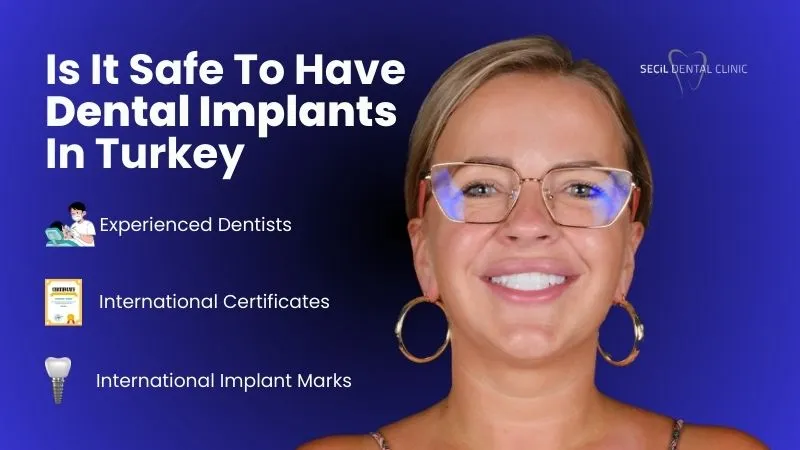
The safety of dental implant treatments in Antalya is one of the topics patients are most curious about. Safety is not just about a sterile environment; it is a combination of state supervision, international standards, advanced technology, and ethical medical practices. Successful clinics in Turkey build this safety on three main pillars: Ministry of Health standards, clinic licensing, and international accreditation.
All healthcare institutions in Turkey are subject to strict supervision and regulations by Ministry of Health. This applies to all dental practices, including implant treatment. These regulations create a comprehensive safety umbrella that puts the patient at the center:
Medical and clinical licence requirement:
Sterilization and infection control protocols:
Medicinal product and medical device regulation
Patient rights and informed consent:
Leading dental clinics in Turkey not only comply with local laws but also adhere to the highest quality and safety standards recognized worldwide. This is one of the most important safeguards for international patients.
Dental implant treatment in Turkey is protected by a double-layered safety net. The first layer consists of the state's strict legal regulations and inspections; the second layer comprises the international accreditations that clinics voluntarily undergo and successfully pass. This combination promises patients not only a successful implant but also a safe, predictable, and high-standard treatment experience.
JCI (Joint Commission International) Accreditation:
ISO (International Organization for Standardization) Certificates:
ISO 9001, which certifies the quality management system, and ISO 13485, which certifies the medical device quality management system, are important certificates obtained by many clinics. These certificates demonstrate that processes are standardized, measurable, and open to continuous improvement.
Turkish Ministry of Health ‘Health Tourism Authorization Certificate’:
This certificate indicates that organizations providing services to foreign patients also meet the accommodation, interpreting, transport, and patient communication standards set by the Ministry. This guarantees that, in addition to the medical aspect of treatment, the patient experience will also be of a certain quality level.
Regular inspection and transparent review mechanisms:
In Turkey, dentists at leading clinics, particularly those serving international patients, are not merely individuals with basic dental training; they are professionals who have specialized in implantology, continuously developed their skills through further education, and gained experience through a high volume of surgical procedures.
Clinical practice intensity: Successful implant dentists in Turkey have significantly more case experience than many of their colleagues abroad. The intensity of dental tourism allows a dentist to perform dozens of implant surgeries per month and hundreds per year. This intensity allows for routine handling of simple cases and in-depth expertise in complex cases (advanced bone loss, full-mouth rehabilitation).
Complex case management: They are frequently experienced in protocols such as bone grafting (sinus lifting, bone powder applications), zygoma (cheekbone) implants, or all-on-4/all-on-6. This broadens the range of treatments and provides the ability to find a solution for almost any case.
Core specialization and continuing education: Many dentists have completed formal subspecialty training (doctorate) in oral implantology, oral and maxillofacial surgery, or periodontology (gum disease and surgery).
International certification programs: Dentists participate in certified surgical and prosthetic training programs organized by world-renowned implant brands. These programs provide expertise in materials science and the latest surgical protocols.
Conference and seminar participation: Active participation in major dental conferences held in Europe and America (such as EAO and ITI Hours) keeps knowledge at the highest level.
Yes, absolutely. Reputable clinics in Turkey use premium and mid-range implant brands that are globally recognized leaders, with success rates scientifically proven. The cost advantage stems not from low-quality materials but from Turkey's position in the supply chain and exchange rate differences.
Examples of brands used: Straumann (Switzerland), Nobel Biocare (Switzerland/USA), Astra Tech (Switzerland), Zimmer Biomet (USA), BioHorizons (USA), and Megagen (South Korea).
Quality assurance: All these brands are CE (European Union) and FDA (US) approved. Furthermore, registration with the Turkish Medicines and Medical Devices Agency (TİTCK) is mandatory in Turkey. Patients have the right to know the brand and serial number of the implant to be used and to see this information in their treatment report.
Cone Beam 3D Tomography (CBCT): This is indispensable prior to implant placement. Most clinics have this device on site. With CBCT, the height, width, density, nerve pathways, and precise location of sinus cavities in the jawbone are determined with millimeter accuracy.
Guided Surgery: 3D tomography data and digital measurements are combined using special software to design a surgical template. This template ensures that implants are placed in the planned position, angle, and depth, with minimal incision and maximum safety. Surgery becomes faster, less traumatic, and more accurate.
Central sterilisation services department (CSSD): All surgical instruments, except single-use items, are sterilized in Class B autoclaves. These autoclaves represent the most advanced standard, capable of eliminating even the most resistant bacterial spores.
Disposable materials: Needles, syringes, gloves, drapes, saliva ejectors, surgical gowns, and even some rotary instrument tips are disposable.
Strict aseptic protocol: Operating theaters or sterile surgical rooms comply with international standards for ventilation systems and surface disinfection.
A reliable clinic has a proactive plan for managing complications:
Preventative approach: The risk of complications is minimized from the outset through detailed planning (CBCT, general health history).
Emergency protocols: An emergency response team and equipment are available within the clinic or at a fully equipped hospital with which it has an agreement.
International warranty and follow-up: Reputable clinics provide long-term (5-10 years or lifetime) international warranties for implants and prostheses. This warranty covers material and workmanship defects.
Remote follow-up after treatment: Patients can communicate with a dentist in their own country. The Turkish clinic sends a comprehensive report in English to the patient and/or their dentist, containing the details of the treatment, X-rays, and care instructions. In addition, problems are assessed through online consultation (tele-dentistry).
Yes, it is safe with proper planning. Safety is ensured both medically and logistically.
Medical suitability: Long flights and travel can pose a risk for those with systemic conditions such as controlled hypertension or diabetes. You must obtain travel approval from your doctor.
Accommodation and transport: Reputable clinics offer airport transfers, secure accommodation close to the clinic, and a companion service. This eliminates the risk of the patient getting lost in an unfamiliar city or using unsafe transport.
Travel insurance: It is advisable to take out special travel health insurance that covers the treatment.
Yes. This is Turkey's biggest advantage in dental tourism: it is not a difference in ‘quality cost’ but in ‘labor and general operating costs.’
The labor costs for doctors and technicians are lower compared to Europe or the USA. The tax structure of clinics and high patient volume reduce the unit cost. A Swiss-made implant of the same quality reaches the patient at a much more affordable price in Turkey.
No compromise on quality:
All the safety protocols, certifications, quality materials, and experienced doctors mentioned above are provided within this low-cost structure. The patient does not compromise on quality; on the contrary, they receive the same quality at a more affordable price.
You may find the following checklist useful when conducting your research:
Physician credentials and experience: Research the physician's CV, area of expertise, years of experience in implant surgery, and training courses attended.
Clinical accreditations: JCI accreditation is the strongest indicator. ISO 9001/13485 and the Ministry of Health's Health Tourism Certificate should also be checked.
Technological infrastructure: Does the clinic have its own 3D tomography (CBCT) and digital surgical planning/template capabilities?
Brands of materials used: Implant brand to be used should be specified in writing in the offer. Globally recognized brands are preferred.
Warranty and aftercare policy: Read the terms and conditions of the international written warranty certificate provided for implants and prostheses. How is remote follow-up provided after treatment?
Transparent and comprehensive pricing: The quote should clearly include all procedures (consultation, surgery, implant, temporary/permanent prosthesis, tomography, medication, and check-ups) and additional services (interpreter, transfer, and accommodation). There should be no surprise additional fees.
Previous patient reviews and references: Look at reviews on various social media platforms and case studies (before/after) on the clinic's own website. Look for realistic and detailed reviews.
Initial contact and consultation: Are the staff knowledgeable, patient, and transparent? Do they provide satisfactory answers to your questions? Do they offer a free online consultation and provide you with a personalized treatment plan and visual simulation? This is the first indicator of the clinic's professionalism.
Make An Appointment Today With Our Online Form